Research: Why futsal contributes to football development
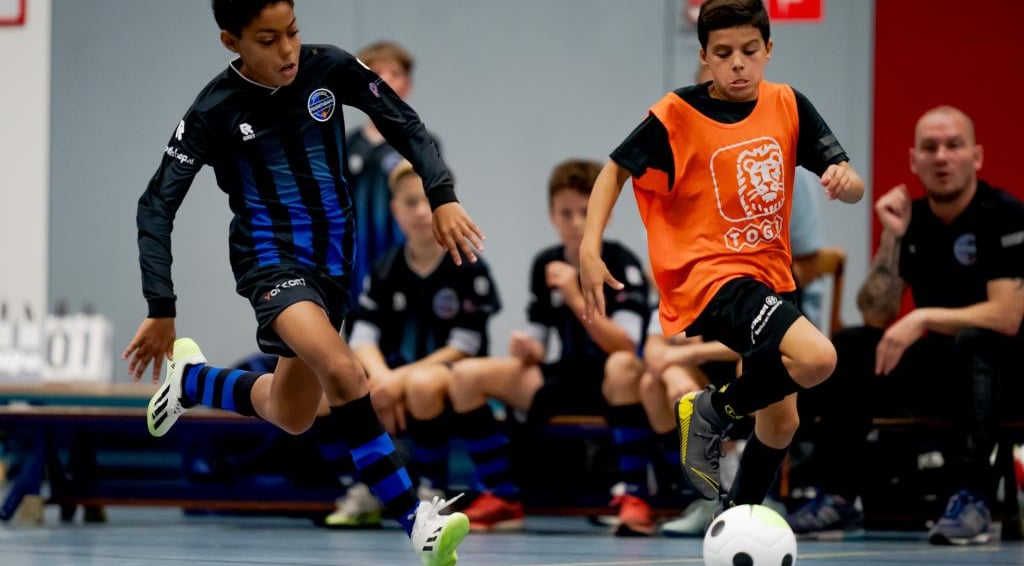
Research and practical experience show that indoor soccer trains important soccer skills that contribute to the development of soccer players, especially on a technical and cognitive level.
Mijn berichteninhoud
Futsal is a fully-fledged professional sport worldwide, with its own elite sports structure and international competitions. At the same time, the game can offer unique added value for the development of field footballers. Great players like Cristiano Ronaldo, Lionel Messi, and – closer to home – Tijjani Reijnders say that futsal has helped them become better footballers. "How does that work?" wondered English scientist and (futsal) coach Christopher Yiannaki. He launched a scientific study to discover the influence of futsal on the development of football talent.
"Growing up in Portugal, I played a lot of futsal. The small pitch helped me develop quick footwork. The nature of the game gave me a sense of freedom to try anything. Without futsal, I wouldn't have become the footballer I am today." - Cristiano Ronaldo
"As a boy, I played futsal on the courts and for my club in Argentina. It was great fun and really helped me in my development as a professional footballer." - Lionel Messi
The aforementioned anecdotal evidence comes as no surprise to English academic and futsal coach Christopher Yiannaki. As coach of an Under-18 futsal team, he witnessed firsthand how much energy the game unleashed in the players thanks to the high tempo and frequent ball contacts. "I saw them enjoying it, and not only that. Their speed of action and ability to make quick decisions increased enormously thanks to the limited space and constant pressure on the ball."
The experiences with his youth team inspired Yiannaki, with support from the University of Central Lancashire, to conduct a PhD research project on the impact of futsal on the development of football skills. His research, which resulted in a scientific publication in Biology of Sport (2020), rested on two pillars: the physical impact of futsal and the development of footballing skills such as receiving, passing, and dribbling. Yiannaki's research can be read in his dissertation or followed in his presentation for the FIFA Training Centre.
Physical Impact:
Yiannaki measured an average heart rate of 164.8 beats per minute in the players during futsal matches. This is 87.7 percent of their maximum heart rate. During transitions or pressure, the players' average heart rate reached 98 percent of their maximum heart rate.
This data shows that the players put a lot of energy into the match. Research into other small-team sports shows that the average heart rate reaches 82-87 percent of their maximum heart rate. Futsal is above this level, making it an intensive small-team sport.
The frequency with which players accelerate and then decelerate is high. So-called 'agile actions', in which players change direction, are also common in futsal. This has a positive effect on player agility.
Football Actions:
Regarding football actions, the research focused on receiving the ball; passing; dribbling; and the frequency with which these occurred.
Receiving the ball
Futsal players receive the ball with the sole of their foot more than three-quarters of the time. The squishy ball and the hard, even surface contribute to a smooth receiving, giving players more time to assess the situation. This helps them develop their scanning ability.
Passing
Futsal has a high passing rate per player, averaging 54 passes per game. Around 84% of these passes are successful. This is higher than in field football, where the average percentage of successful passes remains at 76%. One explanation for this is the smaller field, which rarely involves long passes in futsal.
Dribbling
Futsal is played in small teams. Space is limited. Futsal players are therefore more proactive and have to defend more often. They take more shots on goal, score more, make more saves, and dribble more. The result: their speed of action increases, and players gain more confidence. This confidence carries over to the field, where, thanks to the experience gained in futsal, they also dare to dribble more often.
Conclusion:
Yiannaki's research provides a scientific basis for the anecdotal evidence from Messi, Ronaldo, and Reijnders, as well as his own observations as a youth coach. He demonstrates that futsal has a comparable physical load to field football and requires many repetitive technical actions.
Futsal is an intensive, small-sided team sport. The number of accelerations and decelerations places high demands on a futsal player's agility. This is also increasingly demanded on the field. Futsal is therefore an excellent training tool for field football players in this area!
Don't miss any information and stay informed about special events, Centurion football camps, and more..
Sign up for our newsletter